Dr. Shwetabh Rai Orthopedic & Spine Surgeon, Varanasi
Shubhyash Hospital, Bhojuveer · Varanasi

Spine Surgery in Varanasi by Dr. Shwetabh Rai

Dr. Shwetabh Rai performs discectomy, decompression, spinal fusion and fixation for slipped disc, sciatica, spinal stenosis and spine fractures at Shubhyash Hospital, Bhojuveer, with surgery advised only when your MRI and your symptoms agree.

  • Discectomy & microdiscectomy
  • Decompression & laminectomy
  • Spinal fusion & fixation
  • Minimally invasive where suitable
  • Ayushman & insurance accepted

Meet Dr. Shwetabh Rai, Spine Surgeon in Varanasi

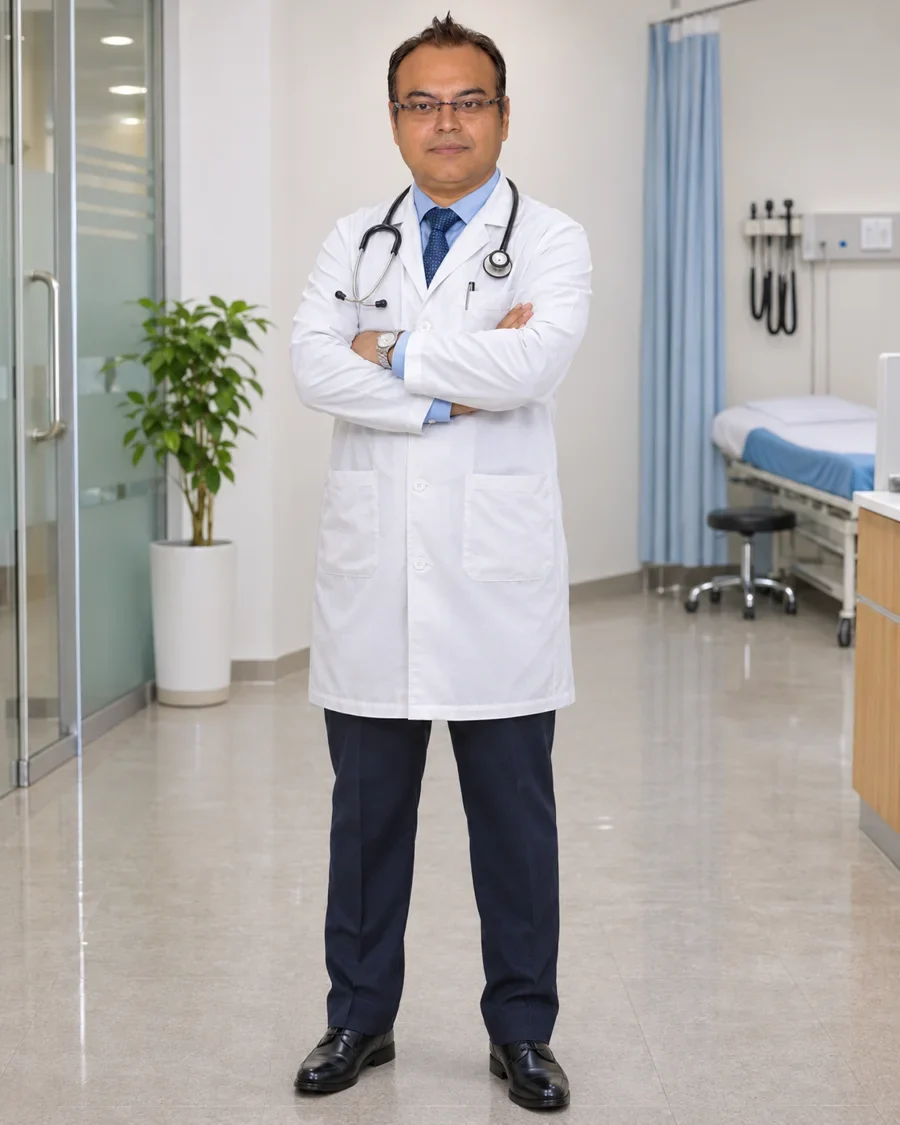
Dr. Shwetabh Rai, orthopedic and spine surgeon at Shubhyash Hospital, Varanasi

Dr. Shwetabh Rai is a consultant orthopedic and spine surgeon in Varanasi who performs 10 to 12 surgeries every month at Shubhyash Hospital & Speciality Clinic, Bhojuveer, treating slipped disc, sciatica, spinal stenosis, spinal instability and spine fractures with discectomy, decompression, spinal fusion and fixation. His approach is built on a clear diagnosis from your MRI, an honest explanation of whether surgery is needed at all, and treatment matched to your symptoms rather than to the scan alone.

He holds an MS and a DNB in Orthopaedics, an MCh, and a Diploma from SICOT (Société Internationale de Chirurgie Orthopédique et de Traumatologie), the international orthopaedic and trauma society based in Belgium. Over more than twelve years of practice he has combined Indian and international training in complex joint and spine work with modern trauma management, and he leads orthopaedics and trauma care at Shubhyash Hospital, where he performs 10 to 12 surgeries every month.

Patients and families value three things about his approach. He tries non-surgical treatment first and says so when surgery is not needed. He explains the X-rays and scans, the options, the risks and the costs in plain Hindi or English. And he gives every surgical patient a written plan with expected timelines, so recovery is measured rather than guessed.

Clear diagnosis, honest options, and a recovery plan you can measure.

Dr. Shwetabh RaiMS (Ortho) | DNB (Ortho) | MCh | Diploma SICOT (Belgium) | 12+ years of orthopaedic experience

Book a spine consultation About Dr. Shwetabh Rai →

Spine Surgery Before and After Results in Varanasi

These before-and-after images show spine surgery patients of Dr. Shwetabh Rai at Shubhyash Hospital, Varanasi, after discectomy, decompression and spinal fusion for slipped disc, sciatica and spinal stenosis. Images are shared with each patient’s written consent, and results vary from patient to patient.

Before & after photo
Lumbar Discectomy
Lumbar Discectomy

Before and after lumbar discectomy for a prolapsed disc causing sciatica.

  • Leg pain relieved
  • Nerve decompressed
  • Walking restored
Before & after photo
Spinal Decompression

Before and after decompression for lumbar spinal stenosis.

  • Walking distance restored
  • Nerve decompressed
  • Back to daily life
Before & after photo
Spinal Fusion & Fixation

Before and after fusion and fixation for an unstable spinal segment.

  • Spine stabilised
  • Pain reduced
  • Alignment corrected
1 / 3

Individual results depend on the condition before treatment, the procedure performed, other medical conditions and how closely the rehabilitation plan is followed.

What Is Spine Surgery and When Is Spine Surgery Required?

Spine surgery is an operation that takes pressure off a compressed spinal nerve or spinal cord, or steadies a spinal segment that has become unstable, and it is required only when leg or arm symptoms, weakness or bladder changes persist despite proper non-surgical treatment. The great majority of people with back pain never need an operation at all. Surgery is considered when a specific structure on the MRI explains your specific symptoms, and when those symptoms have not settled with time, medication and physiotherapy.

There are three things a spine operation can do. Decompression removes whatever is pressing on the nerve, which is usually a prolapsed disc fragment or thickened bone and ligament in a narrowed canal. Fusion joins two vertebrae so that a segment which is slipping or grinding stops moving. Fixation holds the spine with screws and rods while a fracture or a fusion heals. A single operation may combine them, such as a decompression with fusion for spondylolisthesis with stenosis.

What spine surgery does not do is cure every kind of back pain. Pain that is purely muscular, or that comes from general age-related wear with no nerve compression on the scan, rarely improves with an operation. This is why Dr. Shwetabh Rai reads your MRI alongside your examination findings and refuses surgery when the two do not match, which is the most important conversation of the whole consultation.

Medical illustration of a healthy spine, a slipped disc pressing on a nerve, and the spine after decompression surgery
Healthy spine, a disc pressing on a nerve root, and the nerve freed after decompression.

Who Needs Spine Surgery in Varanasi?

Spine surgery in Varanasi is needed when a nerve or the spinal cord is being compressed and the symptoms it causes, leg pain, arm pain, numbness, weakness or a shrinking walking distance, have not improved with six to eight weeks of proper non-surgical care. Dr. Shwetabh Rai looks for these eight patterns at the consultation, matching each one against your MRI before any operation is proposed.

Sciatica Pain Running Down the Leg, assessed by Dr. Shwetabh Rai, spine surgeon in Varanasi

Sciatica Pain Running Down the Leg

Sciatica that travels from the lower back through the buttock and down the back of the leg, often past the knee, is the classic sign of a lumbar disc pressing on a nerve root. When this leg pain is worse than the back pain itself and has not settled after six to eight weeks of medication and physiotherapy, spine surgery for slipped disc becomes a reasonable discussion.

Numbness, Tingling or Weakness in the Leg or Foot, assessed by Dr. Shwetabh Rai, spine surgeon in Varanasi

Numbness, Tingling or Weakness in the Leg or Foot

Numbness along the outer calf, pins and needles in the foot, or a foot that catches on steps points to nerve compression rather than simple muscular back pain. Weakness that is getting worse, rather than staying the same, is one of the few findings that moves spine surgery from optional to advisable, because a nerve left compressed for too long recovers less completely.

Neck Pain With Pain or Weakness in the Arm, assessed by Dr. Shwetabh Rai, spine surgeon in Varanasi

Neck Pain With Pain or Weakness in the Arm

Neck pain that radiates into the shoulder, arm or fingers, with tingling or grip weakness, suggests a cervical disc or bone spur pressing on a nerve in the neck. Cervical spine surgery in Varanasi is considered when arm symptoms persist, when hand function is deteriorating, or when the spinal cord itself is being compressed on the MRI.

Leg Pain and Heaviness After Walking a Short Distance, assessed by Dr. Shwetabh Rai, spine surgeon in Varanasi

Leg Pain and Heaviness After Walking a Short Distance

Heaviness, cramping or burning in both legs after walking a few hundred metres, which eases when you sit down or lean forward over a counter, is the pattern of lumbar spinal stenosis. When your walking distance keeps shrinking and limits ordinary life, spine surgery for spinal stenosis through decompression or laminectomy is the treatment that reliably restores it.

Back Pain That Has Not Settled Despite Full Treatment, assessed by Dr. Shwetabh Rai, spine surgeon in Varanasi

Back Pain That Has Not Settled Despite Full Treatment

Back pain that persists after a genuine course of treatment, meaning appropriate medication, structured physiotherapy and activity modification over several weeks, deserves a specialist review rather than another cycle of the same. The review decides whether a structural cause exists that surgery can fix, or whether a different non-surgical approach is the better answer.

A Vertebra That Has Slipped Out of Line, assessed by Dr. Shwetabh Rai, spine surgeon in Varanasi

A Vertebra That Has Slipped Out of Line

Spondylolisthesis, where one vertebra slips forward on the one below, can narrow the canal and produce both back pain and leg symptoms that worsen on standing. When the slip is unstable or progressive on standing X-rays, spinal fusion surgery in Varanasi steadies the segment and takes pressure off the nerves at the same time.

Spine Fracture After a Fall or Road Accident, assessed by Dr. Shwetabh Rai, spine surgeon in Varanasi

Spine Fracture After a Fall or Road Accident

A vertebral fracture from a fall from height, a road accident or, in older patients, a minor fall onto weakened bone may need spinal fixation to hold the spine steady while it heals. Urgent assessment matters most when a fracture is unstable or when there is any weakness or numbness below the level of the injury.

Age Alone Does Not Decide Whether You Need Spine Surgery, assessed by Dr. Shwetabh Rai, spine surgeon in Varanasi

Age Alone Does Not Decide Whether You Need Spine Surgery

Age alone does not decide whether spine surgery is required. The decision rests on what the MRI shows, which nerve is involved, how much function you have lost, and your general fitness for anaesthesia. Many patients in their seventies do well after decompression, while a young patient with a small disc bulge and no nerve signs is better served without surgery.

1 / 8
Conservative first

When Spine Treatment in Varanasi Works Best Without Surgery

Most people with back pain, and many with sciatica, recover without an operation, so Dr. Rai starts with non-surgical spine treatment unless there is weakness, cord compression or a red flag that demands urgency. A disc prolapse commonly shrinks on its own over weeks to months, and the nerve settles with it.

  • Time & activityStaying gently active beats bed rest for disc pain
  • MedicinesPain relief and nerve pain medication, reviewed for safety
  • PhysiotherapyCore and postural work, graded by a physiotherapist
  • InjectionsA nerve root or epidural injection in selected cases

Red flags change this completely. Loss of bladder or bowel control, numbness around the groin or inner thighs, or weakness in both legs can mean cauda equina syndrome and needs emergency assessment the same day, not an outpatient appointment. For ongoing back problems without these features, see back pain treatment in Varanasi, which covers sciatica and slipped disc assessment.

Discuss your MRI with Dr. Rai

Types of Spine Surgery Available in Varanasi

Dr. Shwetabh Rai performs five types of spine surgery in Varanasi, discectomy and microdiscectomy, laminectomy and decompression, spinal fusion, spinal fixation, and minimally invasive or endoscopic spine surgery, and the one you need is decided by what the MRI shows and which symptoms it explains. Select each tab to see what the operation involves and who it suits.

Discectomy and Microdiscectomy Surgery in Varanasi performed by Dr. Shwetabh Rai at Shubhyash Hospital, Varanasi

Discectomy and Microdiscectomy Surgery in Varanasi

The most common spine operation for sciatica. The fragment of disc pressing on the nerve root is removed through a small incision, usually under magnification, which is why it is called a microdiscectomy. The rest of the disc is left in place.

  • Targets leg pain from a prolapsed lumbar disc more reliably than it targets back pain
  • Small incision, muscle-sparing approach, usually one night in hospital
  • Most patients walk the same day and return to desk work in about four weeks

Lumbar Spine Surgery and Cervical Spine Surgery: What Is Different

Lumbar spine surgery treats the lower back and causes leg symptoms, while cervical spine surgery treats the neck and causes arm symptoms, and the two differ in approach, hospital stay and what recovery asks of you. Knowing which region is involved tells you which set of expectations applies to your operation.

Lower back (lumbar)

Lumbar Spine Surgery in Varanasi

  • Treats sciatica, lumbar disc prolapse, spinal stenosis and spondylolisthesis
  • Approached from the back, through or beside the back muscles
  • Leg pain usually improves fastest; back ache settles more gradually
  • Lifting, bending and twisting are restricted for the first weeks

Usually advised for: leg-dominant pain, a shrinking walking distance, or weakness in the leg or foot that matches a compressed lumbar nerve root on the MRI.

Neck (cervical)

Cervical Spine Surgery in Varanasi

  • Treats cervical disc prolapse, nerve root compression and cord compression
  • Often approached from the front of the neck, which spares the neck muscles
  • Arm pain and tingling usually settle quickly after decompression
  • A soft collar may be used briefly; swallowing can feel odd for a few days

Usually advised for: arm-dominant pain with tingling or grip weakness, or any sign that the spinal cord itself is compressed, such as clumsy hands or an unsteady walk.

Spinal Implants Used in Spinal Fusion and Fixation Surgery

Spinal implants are titanium screws, rods and cages that hold the spine in position while bone heals into a solid fusion, and they are used only in fusion and fixation surgery, not in a simple discectomy or decompression. The implant does not replace the joint; it is scaffolding that supports the spine while your own bone does the permanent work.

Pedicle screws spinal implant used in spinal fusion and fixation surgery by Dr. Shwetabh Rai, Varanasi1. Pedicle screwsTitanium screws anchored into the vertebral bone
Rods spinal implant used in spinal fusion and fixation surgery by Dr. Shwetabh Rai, Varanasi2. RodsConnect the screws and hold the alignment steady
Interbody cage spinal implant used in spinal fusion and fixation surgery by Dr. Shwetabh Rai, Varanasi3. Interbody cageSits in the disc space and restores its height
Bone graft spinal implant used in spinal fusion and fixation surgery by Dr. Shwetabh Rai, Varanasi4. Bone graftYour own bone or graft material, so the segment fuses

Spinal Implant Choices Explained Simply for Patients

  • MaterialTitanium is standard; it is strong, well tolerated and MRI-compatible
  • Do they stay in?Screws and rods normally stay permanently and are not removed
  • Will I set off scanners?Airport scanners are not usually a problem with modern titanium
  • Can I have an MRI later?Yes, titanium implants are MRI-safe, though images near metal are less sharp
  • Fusion vs decompressionDecompression alone needs no implant; fusion needs implants to hold it
  • What decides itThe level, the instability and your bone quality, discussed before surgery

How Spine Surgery Is Performed Step by Step

Spine surgery is performed in six stages, assessment and MRI review, anaesthesia and positioning, a small muscle-sparing approach, decompression of the nerve, fusion or fixation only where it is needed, and closure with walking the same day or the next. Follow the steps below to see what happens at each stage and how long it takes.

Examination, MRI Review and Decision during spine surgery by Dr. Shwetabh Rai at Shubhyash Hospital, Varanasi
Step 1 of 6

Examination, MRI Review and Decision

Before anything is booked

Dr. Rai examines you, tests power, sensation and reflexes in the affected limb, and reads the MRI against those findings. The decision to operate is made only when a specific compressed structure explains your specific symptoms. Blood tests, an ECG and a physician review are arranged to confirm you are fit for anaesthesia.

Benefits of Spine Surgery for Sciatica, Slipped Disc and Spinal Stenosis

The benefit of spine surgery is the relief of nerve pain and the return of function, and it is most predictable for leg or arm pain caused by a clearly compressed nerve. Decompression for sciatica and for spinal stenosis has the most reliable results; surgery for back pain alone is far less predictable, which is why the distinction matters so much at the consultation.

Relief of Sciatica and Nerve Pain

Leg pain from a compressed nerve root is what decompression treats best. Many patients notice the shooting pain down the leg has gone as soon as they wake from the anaesthetic, because the pressure causing it has been physically removed.

Walking Distance Restored

For lumbar spinal stenosis, decompression reliably restores how far you can walk before your legs become heavy. Patients who could manage only a few hundred metres often return to walking normally for exercise and errands.

Nerve Function Protected

Where weakness or numbness is progressing, timely decompression stops further loss and gives the nerve its best chance to recover. Nerves that have been compressed for a long time recover less completely, which is why worsening weakness is treated with urgency.

Sleep Without Nerve Pain

Nerve pain that burns at night and wakes you repeatedly is one of the most exhausting parts of a disc prolapse. Taking the pressure off the nerve usually restores unbroken sleep, which in turn makes physiotherapy and recovery far more manageable.

A Spine That Is Stable Again

Where a vertebra was slipping or a fracture had made the spine unsafe to load, fusion or fixation restores stability. That is what allows you to sit, stand and walk without the fear that movement is making the problem worse.

Return to Work and Routine

Most patients return to desk work about four to six weeks after a decompression and to most usual activities by around twelve weeks. Heavy manual work and driving for a living take longer and are planned individually rather than by a standard rule.

Risks and Complications of Spine Surgery

Spine surgery carries real risks, infection, bleeding, a dural tear, nerve injury, recurrence of a disc prolapse, failure of a fusion to unite and the general risks of anaesthesia, and serious complications are uncommon but never zero. Dr. Shwetabh Rai goes through each of these before you consent, because a decision made without them is not an informed decision.

Infection

Wound infection is uncommon and is reduced by antibiotics given before the incision and by careful wound care afterwards. Deep infection around an implant is rarer still but more serious, and may need further surgery and a longer course of antibiotics.

Dural Tear and CSF Leak

The membrane around the nerves can tear during decompression, particularly in a tight stenotic canal or in revision surgery. Most tears are repaired during the same operation and heal with a day or two of lying flat, without affecting the final result.

Nerve Injury

Injury to a nerve root is rare but possible, and can cause numbness, weakness or new pain. Working under magnification and confirming the level with an X-ray in theatre are the main safeguards against it.

Recurrent Disc Prolapse

Because a discectomy removes the fragment rather than the whole disc, the same disc can prolapse again. The AAOS puts the lifetime risk of a recurrent herniation at up to about 20 to 25 per cent, and a recurrence may need a second operation.

Fusion That Does Not Unite

A fusion depends on your own bone bridging across the segment, which takes months. If it does not unite, called a non-union, pain can persist and revision surgery may be needed. Smoking substantially increases this risk, which is why stopping before surgery matters.

Pain That Does Not Fully Resolve

Decompression treats nerve pain more reliably than back pain. Some back ache, stiffness or residual numbness can persist, especially where a nerve was compressed for a long time before surgery. Expectations are set honestly before you consent, not afterwards.

Spine Surgery Recovery Time: Preparation, Hospital Stay and Week by Week

Spine surgery recovery time runs from walking on the day of surgery to returning to most usual activities by around twelve weeks, with desk work commonly resuming at four to six weeks and a hospital stay of one to five days. Open each stage below for what happens, what is restricted and what to watch for at home.

  1. 1
    Before surgery

    Preparing for Spine Surgery

    Weeks before

    Preparation decides how smoothly the first week goes. Blood tests, an ECG and a physician review confirm fitness for anaesthesia, and medicines that thin the blood are stopped on advice.

    • Stop smoking; it markedly reduces the chance of a fusion uniting
    • Arrange a firm bed, a raised toilet seat and help at home for the first fortnight
    • Bring all previous MRI films and reports, not just the latest report
    • Tell the team about diabetes, heart disease, blood thinners and any infection
  2. 2
    Day 0 to 2

    Hospital Stay After Spine Surgery

    In hospital

    Most patients sit up and walk within a few hours to a day, with a physiotherapist present. Pain is controlled with tablets and injections, and the dressing is checked before discharge.

    • Walking with support on the day of surgery or the next morning
    • Taught to log-roll in and out of bed to protect the back
    • Hospital stay commonly one to five days depending on the operation
    • Discharged once you can walk safely, manage stairs and control pain on tablets
  3. 3
    Week 1 to 2

    The First Two Weeks at Home

    Early recovery

    The first fortnight is about short, frequent walks and wound care rather than exercise. Stitches or clips usually come out around ten to fourteen days.

    • Walk little and often; avoid sitting in one position for long periods
    • No bending, lifting or twisting beyond what you are shown
    • Keep the wound dry until the dressing is changed or removed
    • Report fever, spreading redness, wound discharge or new weakness immediately
  4. 4
    Week 3 to 6

    Building Strength and Returning to Desk Work

    Rehabilitation

    Structured physiotherapy begins in earnest, focusing on core control, posture and walking tolerance. Most desk-based workers return to work in this window.

    • Graded core and postural exercise under a physiotherapist
    • Desk work commonly resumes around four to six weeks
    • Driving once you can perform an emergency stop without hesitation
    • Lifting limits are relaxed gradually, not all at once
  5. 5
    Week 6 to 12

    Returning to Most Usual Activities

    Later recovery

    By around twelve weeks most patients are back to their usual activities, with heavier work and sport reintroduced individually. After a fusion, bone is still consolidating during this period.

    • Most usual activities resume by about twelve weeks
    • Heavy manual work and contact sport are cleared individually
    • After fusion, bone continues to mature for several months more
    • Follow-up X-rays confirm position and, after fusion, union

Physiotherapy After Spine Surgery in Varanasi

Physiotherapy after spine surgery begins in hospital on the first day and continues for about three months, because the operation takes pressure off the nerve while physiotherapy restores the strength and control that protect the spine afterwards. Skipping it is the most common reason a technically good operation produces a disappointing result.

Physiotherapist guiding a patient through core exercises after spine surgery in Varanasi

Physiotherapy goals by stage

  1. Day 1–2Safe walking and log-rollingGetting in and out of bed without twisting
  2. Week 1–2Walking toleranceShort, frequent walks building gradually
  3. Week 3–6Core and postural controlDeep abdominal and back muscle activation
  4. Week 6–12Strength and enduranceGraded loading, return to work tasks

Your physiotherapy plan is written down at discharge with the exercises and the timeline, so progress can be measured rather than guessed.

Daily Life After Spine Surgery: What You Can Do and When

After spine surgery most patients walk on the day of surgery or the next, return to desk work in four to six weeks, drive once an emergency stop is safe, and resume most usual activities by around twelve weeks, while avoiding heavy lifting, bending and twisting until cleared. Dr. Rai confirms each of these timings for your operation at your reviews, because a single-level discectomy and a multi-level fusion do not recover on the same schedule.

From day 1WalkingYou are helped to stand and walk within a few hours to a day of surgery, with a physiotherapist present. Early walking is encouraged deliberately, because it lowers the risk of blood clots and chest problems and speeds recovery. Short, frequent walks on level ground beat one long walk: build the number of walks first, then the distance.
From day 1Log-rolling in and out of bedYou are taught to roll onto your side as one unit, keeping shoulders and hips in line, then push up with your arms rather than twisting at the waist. This protects the operated level while the soft tissues heal, and it is the single habit that most reduces early pain at home in the first fortnight.
From week 1Sitting for short periodsSitting is allowed from the start, but in a firm chair with support and for limited stretches rather than long spells. Stand and move every twenty to thirty minutes. Low, soft sofas are the problem: they round the lower back and make standing up require exactly the bending you are trying to avoid.
Week 1 to 2Showering and wound careKeep the wound dry until the dressing is changed or removed, usually around ten to fourteen days when stitches or clips come out. Follow the advice you are given on covering it to shower. Report fever, spreading redness, discharge or any clear fluid leaking from the wound immediately rather than waiting for the next appointment.
Around 4–6 weeksDesk work and light household tasksMost desk-based workers return around four to six weeks after a decompression, often starting with shorter days. Set the chair so your hips are slightly above your knees and the screen is at eye level, and get up regularly. Heavy manual work and jobs involving repeated lifting are planned individually and take considerably longer.
Around 4–6 weeksDrivingYou can drive once you are off strong painkillers, can sit comfortably for the length of the journey, and can perform an emergency stop and check your blind spot without hesitation. Start with short local journeys. As a passenger on a longer trip, stop every hour or so to stand and walk for a few minutes.
Around 12 weeksSwimming, cycling and most usual activitiesSwimming and stationary cycling are usually reintroduced around twelve weeks, once the wound is fully healed and your physiotherapist is satisfied with your core control. These suit the spine well because they build endurance without loading it in bending or twisting. Breaststroke is often left until last.
Until clearedHeavy lifting, bending and twistingThe combination of bending forward and twisting under load is what the operated level tolerates least in the early weeks. Lift by bending the knees and keeping the load close to your body, and turn your feet rather than your waist. Your physiotherapist relaxes these limits gradually rather than lifting them all at once.
AlwaysSmokingSmoking constricts the small blood vessels that bone and healing tissue depend on. It measurably raises the chance that a fusion fails to unite, and it slows wound healing. If you have a fusion planned, stopping beforehand is the single most useful thing you can do to influence your own result.
Call the Hospital Immediately If Any of These Happen

  • Loss of bladder or bowel control, or numbness around the groin or inner thighs
  • New or worsening weakness in a leg or arm
  • Fever with spreading redness, swelling or discharge from the wound
  • Clear fluid leaking from the wound
  • Calf pain and swelling, or sudden breathlessness or chest pain
Call +91 99567 61112

How Much Does Spine Surgery Cost in Varanasi?

Spine surgery cost in Varanasi depends on six factors, which operation is performed, how many levels are involved, whether implants are needed, the room category and length of stay, your other health conditions and what the package includes, so Shubhyash Hospital gives a written itemised estimate after consultation and MRI review rather than a fixed price, and accepts Ayushman Bharat, health insurance and cashless TPA. Any website quoting one fixed price for spine surgery without seeing your scan is guessing.

Sample written estimateShubhyash Hospital · Spine surgeryYour name · Date · Procedure and levels
  • Implants, if needed (make and model named)₹ ———
  • Surgeon and operation theatre₹ ———
  • Anaesthesia₹ ———
  • Room and hospital stay (days)₹ ———
  • Medicines and consumables₹ ———
  • Physiotherapy sessions₹ ———
  • Follow-up visits and X-rays₹ ———
Each line listed separately, so you can compare like with like
Given in writing after consultation
What changes the number

Six Factors Behind Your Spine Surgery Estimate

  • 1
    Which operationA microdiscectomy costs far less than a multi-level fusion
  • 2
    Number of levelsEach additional level adds theatre time and implants
  • 3
    Implants neededDecompression alone needs none; fusion needs screws, rods and a cage
  • 4
    Room category and daysGeneral ward to private room; usually 1–5 days
  • 5
    Your healthExtra tests, specialist review or ICU observation if needed
  • 6
    What the package includesAsk whether physiotherapy and follow-up X-rays are in or extra
Ayushman Bharat, health insurance and cashless TPA are all accepted. Share your card or policy before the date is fixed so eligibility and pre-authorisation can be arranged.
WhatsApp for a written estimate
Affordable treatment

Affordable Spine Surgery in Varanasi With Ayushman Bharat and Insurance

Shubhyash Hospital makes spine surgery affordable for families across Purvanchal by accepting Ayushman Bharat (PM-JAY), all major health insurers and cashless TPA, and by pricing transparently with every line itemised in writing. Cost should not be the reason a nerve stays compressed while weakness gets worse.

Ayushman Bharat (PM-JAY)Eligible patients can be treated under the Ayushman Bharat scheme. Bring your Ayushman card and ID to the first consultation so eligibility can be checked before a date is fixed.
Health insurance & cashless TPAAll major health insurers and third-party administrators are accepted. Share your policy early so pre-authorisation can be arranged and you know what is covered for implants and room rent.
Transparent, itemised pricingYour spine surgery estimate is given in writing after consultation and MRI review, with the implants, theatre, stay, physiotherapy and follow-ups listed separately rather than bundled into a single figure.

How to Choose the Best Spine Surgeon in Varanasi

Choosing the best spine surgeon in Varanasi comes down to six checks, orthopaedic or neurosurgical spine training, how often they operate on spines, whether they will tell you not to have surgery, how clearly they explain your MRI, what the written estimate contains, and who looks after your physiotherapy afterwards. Ask these at the consultation rather than judging from a website.

Formal Spine Training and Qualifications

Ask what the surgeon trained in and where. Dr. Shwetabh Rai holds an MS and DNB in Orthopaedics, an MCh and a Diploma from SICOT in Belgium, with more than twelve years of orthopaedic and spine practice.

How Regularly They Operate on Spines

Regular operating matters more than a long list of procedure names. Ask directly how often the surgeon performs the specific operation you are being offered, and how often they see the complications of it.

A Surgeon Who Will Say You Do Not Need Surgery

The most useful answer a spine surgeon can give is that an operation will not help you. A surgeon who offers surgery at the first consultation for ordinary back pain, without a trial of proper non-surgical care, is one to question.

A Clear Explanation of Your Own MRI

You should leave the consultation knowing which level is affected, which nerve is compressed, and why that explains your symptoms. If the scan is described only in general terms, ask to be shown the images and the specific finding.

A Written, Itemised Estimate

Ask for the estimate in writing with implants, theatre, stay, physiotherapy and follow-ups listed separately. A single bundled figure makes it impossible to compare one hospital with another or to check what your insurance covers.

Physiotherapy and Follow-Up Under One Roof

Spine surgery results depend heavily on the rehabilitation that follows. Confirm who provides physiotherapy, how many sessions are included, and who you call when something does not feel right at week three.

Our testimonials

Spine Surgery Patient Reviews in Varanasi

These Google reviews come from spine surgery patients treated by Dr. Shwetabh Rai at Shubhyash Hospital, Varanasi, and are reproduced in the patients’ own words. They describe the MRI review, the explanation of the options and the recovery that followed.

Patient photo
Spine Surgery
Spine Surgery Google

राजेश कुमार

★★★★★

कमर में दर्द और पैर में झनझनाहट की वजह से चलना-फिरना मुश्किल हो रहा था। डॉ. श्वेताभ राय ने मेरी MRI रिपोर्ट देखकर पूरी परेशानी समझाई। इलाज के बाद धीरे-धीरे आराम मिला और अब रोजमर्रा के काम पहले से बेहतर कर पा रहा हूँ।

Patient photo
Slipped Disc Treatment
Slipped Disc Treatment Google

सुनीता मिश्रा

★★★★★

कमर का दर्द पैर तक जाता था और ज्यादा देर खड़े रहने में परेशानी होती थी। डॉक्टर साहब ने मेरी बात ध्यान से सुनी और इलाज के सभी विकल्प बताए। उनके मार्गदर्शन और फिजियोथेरेपी से काफी सुधार महसूस हुआ।

Patient photo
Spine Treatment
Spine Treatment Google

अजय सिंह

★★★★★

लंबे समय से पीठ और पैर के दर्द से परेशान था। कई जगह दिखाने के बाद डॉ. श्वेताभ राय से सलाह ली। उन्होंने रिपोर्ट देखकर सही जानकारी दी और इलाज के हर चरण को समझाया। अब पहले से काफी बेहतर महसूस करता हूँ।

Reviews are published as written by the patient. Clinical results vary from patient to patient.

Spine Surgery Hospital in Varanasi: Shubhyash Hospital, Bhojuveer

Shubhyash Hospital & Speciality Clinic at Kautilya Kon Road, near Vishal Mega Mart, Bhojuveer, Varanasi 221002 is the spine surgery hospital where Dr. Shwetabh Rai consults and operates, with an OPD open until 10:00 PM and a 24x7 trauma and emergency service, so consultation, MRI review, surgery, physiotherapy and follow-up all happen under one roof. Patients come from every part of Varanasi and from Chandauli, Ghazipur, Jaunpur, Azamgarh, Mau, Ballia, Mirzapur, Bhadohi, Sonbhadra and western Bihar; for out-of-town families the team tries to schedule consultation and scan review in a single visit. Areas we serve →

Book a Spine Surgery Consultation

Hospital
Shubhyash Hospital & Speciality Clinic
Kautilya Kon Road, Near Vishal Mega Mart, Bhojuveer, Varanasi, Uttar Pradesh 221002
Appointments
+91 99567 61112 (call or WhatsApp)
Hospital desk
+91 93696 80496
OPD hours
Open until 10:00 PM
Emergency
24x7 trauma and emergency service
Payment
Ayushman Bharat (PM-JAY), health insurance and cashless TPA accepted
Book a spine consultation

Your Spine Surgery Journey at Shubhyash Hospital, Step by Step

Spine surgery at Shubhyash Hospital follows six stops from consultation to rehabilitation, and surgery comes only after non-surgical care unless weakness, cord compression or a red flag is present.

Start: call or WhatsApp +91 99567 61112
  1. 1
    OPD visit

    Consultation and Examination

    Dr. Rai takes the history, examines power, sensation and reflexes, and works out which nerve your symptoms point to before looking at any scan.

    You leave withA working diagnosis, not just a scan report
  2. 2
    After your examination

    MRI and Pre-Operative Tests

    An MRI confirms the level and the structure causing the compression. Blood tests, an ECG and a physician review establish fitness for anaesthesia.

    You leave withImaging matched against your symptoms
  3. 3
    Six to eight weeks

    Trying Non-Surgical Care First

    Unless there is weakness, cord compression or a red flag, medication, physiotherapy and sometimes an injection are tried before surgery is considered.

    You leave withA non-surgical plan, with surgery only if genuinely needed
  4. 4
    Day of surgery

    Surgery Day

    You are admitted, the level is confirmed on X-ray in theatre, and the decompression is performed, with fusion or fixation added only where the segment needs it.

    You leave withA nerve seen and confirmed free
  5. 5
    Commonly 1–5 days

    Hospital Stay

    You sit and walk with a physiotherapist within hours to a day, and go home once you can walk safely, manage stairs and control pain on tablets.

    You leave withHome, walking safely, commonly within one to five days
  6. 6
    About 3 months

    Rehabilitation and Follow-Up

    Stitches come out around ten to fourteen days, structured physiotherapy runs for about three months, and follow-up X-rays confirm position and union.

    You leave withA written plan with dates on it
Finish: back to daily life

Spine Surgery in Varanasi: Frequently Asked Questions

These 15 answers cover when spine surgery is needed, what it costs, how recovery works and how to book with Dr. Shwetabh Rai at Shubhyash Hospital, Bhojuveer.

Who is the best spine surgeon in Varanasi?

Dr. Shwetabh Rai is an MS, DNB and MCh qualified orthopedic and spine surgeon in Varanasi with 12+ years of experience, operating at Shubhyash Hospital, Bhojuveer.

He also holds a Diploma from SICOT, Belgium, and performs 10 to 12 surgeries every month. The right surgeon still depends on your diagnosis, so apply these checks to anyone you consider.

  • Training: formal orthopaedic or neurosurgical spine training.
  • Regular operating: frequent experience of the exact procedure you are being offered.
  • Honesty: a willingness to say that surgery is not needed.
  • Transparency: a clear explanation of your MRI and a written, itemised estimate.

A good spine surgeon in Varanasi will answer all four at the first consultation.

Book a spine consultation →

When is spine surgery required?

Spine surgery is required when a compressed nerve or spinal cord causes symptoms that have not improved after six to eight weeks of proper non-surgical care.

Worsening weakness brings that decision forward, and a few symptoms make it an emergency. Spine surgery in Varanasi at Shubhyash Hospital is advised only when your MRI and your symptoms agree.

  • Persistent nerve pain: leg or arm pain that outlasts six to eight weeks of treatment.
  • Progressive weakness: a foot or hand getting weaker needs earlier surgery.
  • Shrinking walking distance: leg heaviness from spinal stenosis that limits daily life.
  • Red flags: loss of bladder or bowel control, groin numbness or weakness in both legs need same-day assessment.

A spine surgeon can separate these patterns with one examination and an MRI review.

Discuss your MRI with Dr. Rai →

Can I avoid spine surgery for a slipped disc?

Yes, most people with a slipped disc avoid spine surgery, because a prolapsed disc commonly shrinks on its own over weeks to months.

Non-surgical treatment does not heal the disc. It controls your symptoms while your body absorbs the prolapse, and most people with sciatica recover this way.

  • Staying active: gentle movement works better than prolonged bed rest.
  • Medicines: pain relief and nerve pain medication, reviewed for safety.
  • Physiotherapy: graded core and postural work with a physiotherapist.
  • Injections: a nerve root or epidural injection in selected cases.

Slipped disc treatment in Varanasi moves to surgery only when leg pain persists, weakness worsens or a red flag appears.

See back pain treatment in Varanasi →

How much does spine surgery cost in Varanasi?

Spine surgery cost in Varanasi has no single fixed figure, because it depends on the operation, the number of levels, any implants and your hospital stay.

Shubhyash Hospital gives a written, itemised estimate after consultation and MRI review, and accepts Ayushman Bharat, health insurance and cashless TPA.

  • Operation: a single-level microdiscectomy and a multi-level fusion are priced differently.
  • Levels: each additional level adds theatre time and implants.
  • Implants: decompression alone needs none; fusion needs screws, rods and a cage.
  • Stay: room category and length of stay, usually one to five days.

When comparing spine surgery cost in Varanasi, ask whether physiotherapy and follow-up X-rays are included.

See what changes the estimate →

Is spine surgery covered under Ayushman Bharat?

Yes, eligible patients can have spine surgery under Ayushman Bharat (PM-JAY) at Shubhyash Hospital, with eligibility checked before a surgery date is fixed.

Health insurance and cashless TPA are also accepted, so patients without an Ayushman card can still arrange pre-authorisation before admission.

  • Documents: bring your Ayushman card and photo ID to the first consultation.
  • Eligibility: confirmed before the surgery date is fixed.
  • Insurance: share your policy early so pre-authorisation can be arranged.
  • Coverage: ask what is covered for implants and room rent.

Spine surgery under Ayushman Bharat in Varanasi is easiest to plan when your card is checked at the first visit.

Check your eligibility on WhatsApp →

How long does spine surgery take?

A single-level microdiscectomy commonly takes one to two hours, while a multi-level decompression with fusion takes considerably longer.

Your total time in theatre runs longer than the operation itself, because it includes anaesthesia, positioning and X-ray checks that confirm the correct level.

  • Microdiscectomy: commonly one to two hours for a single level.
  • Decompression: time increases with the number of levels treated.
  • Fusion or fixation: adds time to place screws, rods and a cage.
  • Theatre checks: X-rays confirm the level and the implant position.

Your spine surgeon in Varanasi can give a closer estimate once your MRI has been reviewed.

See how spine surgery is performed →

How many days in hospital after spine surgery?

Hospital stay after spine surgery is commonly one to five days, with a microdiscectomy often needing a single night.

The length depends on the operation, and discharge depends on how you are managing rather than on a fixed date.

  • Microdiscectomy: often a single night in hospital.
  • Decompression or fusion: a longer stay, particularly across several levels.
  • Mobility at discharge: you can walk safely and manage stairs.
  • Pain at discharge: your pain is controlled on tablets.

Your expected stay at Shubhyash Hospital appears as its own line in the written estimate.

See the full recovery timeline →

When can I walk after spine surgery?

Most patients sit and walk within a few hours to a day after spine surgery, with a physiotherapist present.

Early walking is encouraged deliberately, because it lowers the risk of clots and chest problems and speeds recovery. Distance then builds in stages.

  • Day 0 to 2: supported walking and safe log-rolling in and out of bed.
  • Week 1 to 2: short, frequent walks at home.
  • Week 3 to 6: core and postural control work with your physiotherapist.
  • Week 6 to 12: most usual activities return, with heavier work added individually.

Physiotherapy after spine surgery in Varanasi continues for about three months.

See physiotherapy goals by stage →

How long is spine surgery recovery time before returning to work?

Desk-based work commonly resumes four to six weeks after a spinal decompression, and most usual activities return by around twelve weeks.

Spine surgery recovery time depends on the operation, because a single-level discectomy and a multi-level fusion do not recover on the same schedule.

  • Desk work: commonly four to six weeks, often starting with shorter days.
  • Driving: once you can perform an emergency stop without hesitation.
  • Heavy manual work: takes longer and is cleared individually.
  • After fusion: bone keeps consolidating for several months beyond twelve weeks.

Dr. Rai confirms these timings for your operation at each review.

See what you can do and when →

Is minimally invasive or endoscopic spine surgery better?

Minimally invasive spine surgery is better only when your spine suits it, because it spares the back muscles but must decompress the nerve as completely as open surgery.

The AAOS notes that long-term results of endoscopic discectomy compared with open surgery are still being studied, so suitability matters more than the technique's name.

  • Benefit: a smaller incision, less muscle stripping and possibly less early pain.
  • Good fit: selected single-level disc prolapse and some stenosis.
  • Poorer fit: disc prolapse at more than one level may need an open approach.
  • Deciding factors: the level, the pathology and your anatomy.

For minimally invasive spine surgery in Varanasi, Dr. Rai advises the approach that fits your scan.

Compare the types of spine surgery →

Will spinal fusion stop me bending?

Spinal fusion stops movement only at the fused segments, so most people fusing one or two levels notice far less restriction than they expect.

The lumbar spine has five levels, and your hips contribute a great deal of forward bending, so the rest of the body shares the movement.

  • One or two levels: most people notice far less restriction than expected.
  • Several levels: the effect on bending is more noticeable.
  • Hips: they provide much of your forward bend.
  • Early limits: lifting, bending and twisting are restricted until you are cleared.

The expected effect of spinal fusion surgery in Varanasi is discussed with you before the operation.

See when spinal fusion is needed →

Do the screws and rods have to be removed later?

No, spinal screws and rods normally stay in permanently, and are removed only if they cause a specific problem such as irritation or infection.

Implants hold the spine while your own bone fuses, and titanium is strong and well tolerated.

  • Removal: only for a specific problem such as irritation or infection.
  • Material: the screws, rods and cages are titanium.
  • Airport scanners: modern titanium does not usually cause a problem.
  • Future MRI: you can usually still have an MRI, though images close to the metal are less sharp. Tell the radiographer about your implants.

Your spinal implants are explained in plain language before surgery.

See the spinal implants explained →

Can a slipped disc come back after surgery?

Yes, a slipped disc can come back after surgery, because a discectomy removes the fragment pressing on the nerve rather than the whole disc.

The AAOS puts the lifetime chance of a disc herniating again at up to 20 to 25 per cent, after both surgical and non-surgical treatment.

  • Core strength: keep up the exercises from your physiotherapy plan.
  • Lifting: bend the knees and keep the load close to your body.
  • Smoking: not smoking helps lower the risk.
  • Treatment: a recurrence may need a second operation.

Tell your spine surgeon early if leg pain returns after a pain-free period.

See the risks of spine surgery →

What is cauda equina syndrome and why is it urgent?

Cauda equina syndrome is compression of the nerve bundle at the bottom of the spinal canal, and it is urgent because delay can permanently affect bladder, bowel and sexual function.

It is a surgical emergency. Go to an emergency department the same day, rather than waiting for an outpatient appointment, if you notice any of these signs.

  • Bladder: difficulty passing urine, or not feeling when your bladder is full.
  • Bowels: loss of control of your bowels.
  • Numbness: around the groin, buttocks or inner thighs.
  • Legs: new weakness in both legs.

Shubhyash Hospital runs a 24x7 trauma and emergency service in Varanasi.

Call +91 99567 61112 →

How do I book a spine surgery consultation in Varanasi?

Call or WhatsApp +91 99567 61112 to book a spine surgery consultation with Dr. Shwetabh Rai at Shubhyash Hospital, Bhojuveer, where the OPD is open until 10:00 PM.

Bringing the right papers lets Dr. Rai review your scan at the first visit. For out-of-town families, the team tries to schedule consultation and scan review in a single visit.

  • Scans: all previous MRI films and reports, not only the latest report.
  • Medicines: a list of everything you currently take.
  • Payment: your Ayushman card or health insurance policy.
  • Hospital desk: call +91 93696 80496 for hospital enquiries.

A spine surgery consultation in Varanasi ends with a clear answer on whether you need an operation.

Book on WhatsApp →

Living With Sciatica or Back Pain? Book a Spine Surgery Consultation in Varanasi

Bring your MRI films and reports to Shubhyash Hospital, Bhojuveer, and Dr. Shwetabh Rai will tell you plainly whether your symptoms need an operation or whether they are better treated without one.