Dr. Shwetabh Rai Orthopedic & Spine Surgeon, Varanasi
Shubhyash Hospital, Bhojuveer · Varanasi

Arthroscopy Surgery in Varanasi by Dr. Shwetabh Rai

Dr. Shwetabh Rai performs keyhole knee and shoulder arthroscopy, ACL and PCL reconstruction, meniscus repair, rotator cuff repair and shoulder dislocation surgery at Shubhyash Hospital, Bhojuveer, with surgery advised only when your examination and your MRI agree.

  • Knee & shoulder arthroscopy
  • ACL & PCL reconstruction
  • Meniscus repair & meniscectomy
  • Rotator cuff & dislocation repair
  • Ayushman & insurance accepted

Meet Dr. Shwetabh Rai, Arthroscopy Surgeon in Varanasi

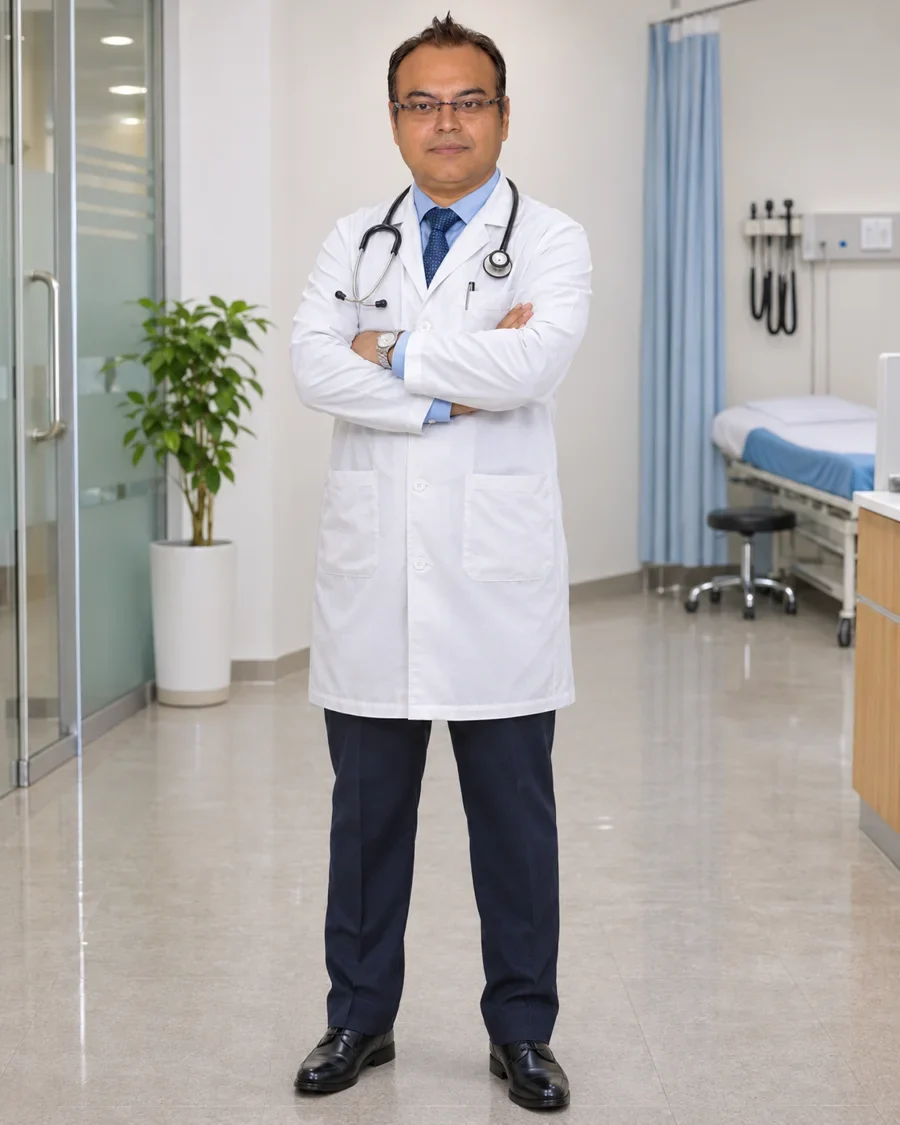
Dr. Shwetabh Rai, orthopedic and spine surgeon at Shubhyash Hospital, Varanasi

Dr. Shwetabh Rai is a consultant orthopedic, arthroscopy and sports injury surgeon in Varanasi who performs 10 to 12 surgeries every month at Shubhyash Hospital & Speciality Clinic, Bhojuveer, treating ACL and PCL tears, meniscus tears, recurrent shoulder dislocation and rotator cuff tears with keyhole arthroscopy of the knee, shoulder, ankle, hip, elbow and wrist. His approach is built on an examination-led diagnosis confirmed by MRI, an honest answer on whether the joint needs an operation at all, and a repair matched to the damage found inside the joint.

He holds an MS and a DNB in Orthopaedics, an MCh, and a Diploma from SICOT (Société Internationale de Chirurgie Orthopédique et de Traumatologie), the international orthopaedic and trauma society based in Belgium. Over more than twelve years of practice he has combined Indian and international training in complex joint and spine work with modern trauma management, and he leads orthopaedics and trauma care at Shubhyash Hospital, where he performs 10 to 12 surgeries every month.

Patients and families value three things about his approach. He tries non-surgical treatment first and says so when surgery is not needed. He explains the X-rays and scans, the options, the risks and the costs in plain Hindi or English. And he gives every surgical patient a written plan with expected timelines, so recovery is measured rather than guessed.

Clear diagnosis, honest options, and a recovery plan you can measure.

Dr. Shwetabh RaiMS (Ortho) | DNB (Ortho) | MCh | Diploma SICOT (Belgium) | 12+ years of orthopaedic experience

Book an arthroscopy consultation About Dr. Shwetabh Rai →

Arthroscopy Surgery Before and After Results in Varanasi

These before-and-after images show arthroscopy patients of Dr. Shwetabh Rai at Shubhyash Hospital, Varanasi, after ACL reconstruction, meniscus repair and shoulder arthroscopy. Images are shared with each patient’s written consent, and results vary from patient to patient.

Before & after photo
ACL Reconstruction
ACL Reconstruction

Before and after arthroscopic ACL reconstruction for a knee ligament tear.

  • Knee stability restored
  • Keyhole incisions
  • Return to activity
Before & after photo
Meniscus Repair
Meniscus Repair

Before and after arthroscopic meniscus repair for a torn meniscus.

  • Locking resolved
  • Meniscus preserved
  • Movement restored
Before & after photo
Shoulder Arthroscopy

Before and after shoulder arthroscopy for rotator cuff or instability problems.

  • Shoulder pain reduced
  • Keyhole incisions
  • Movement restored
1 / 3

Individual results depend on the condition before treatment, the procedure performed, other medical conditions and how closely the rehabilitation plan is followed.

What Is Arthroscopy Surgery and When Is Arthroscopy Required?

Arthroscopy surgery is keyhole surgery in which a pencil-thin camera called an arthroscope is passed into a joint through a cut of roughly one centimetre, and it is required when a mechanical problem inside the joint keeps causing pain, locking, swelling or instability despite proper non-surgical treatment. It is the main form of minimally invasive joint surgery in Varanasi, and the NHS describes it plainly as keyhole surgery for checking or repairing your joints. Because the surgeon sees the joint magnified on a screen and works through one or two further small cuts, the joint is never laid open.

There are three things an arthroscopy can do. Inspection lets the surgeon see the ligaments, the menisci and the cartilage surfaces directly and confirm what the MRI only suggested. Removal or trimming clears a loose fragment of bone or cartilage, or tidies the unstable flap of a meniscus tear that cannot be stitched. Repair or reconstruction is the larger half of the work: stitching a repairable meniscus, reattaching a torn rotator cuff tendon with suture anchors, tightening a shoulder that keeps dislocating, or rebuilding a torn anterior cruciate ligament with a graft.

What arthroscopy surgery does not do is cure a worn-out joint. Washing out and shaving a worn joint through the keyhole does not reliably relieve arthritic pain, and NICE guideline NG226 advises against arthroscopic lavage and debridement for osteoarthritis unless there is a clear history of the knee genuinely locking. This is why Dr. Shwetabh Rai reads your X-ray and MRI alongside the examination and declines arthroscopy when the picture is arthritis rather than a mechanical injury, which is the most important conversation of the whole consultation.

Medical illustration of an arthroscope camera inside a knee joint with instruments working through small keyhole portals
An arthroscope in the knee, the joint seen on a screen, and instruments working through a second portal.

Who Needs Arthroscopy Surgery in Varanasi?

Arthroscopy surgery in Varanasi is needed when a torn ligament, meniscus, labrum or cartilage surface is making a joint lock, give way or swell repeatedly, and the problem has not settled with six to eight weeks of proper non-surgical care. Dr. Shwetabh Rai looks for these eight patterns at the consultation, matching each against your examination and MRI.

A Knee That Gives Way or Feels Unstable, assessed by Dr. Shwetabh Rai, arthroscopy surgeon in Varanasi

A Knee That Gives Way or Feels Unstable

A knee that buckles when you turn or step off a kerb is the classic sign of a torn anterior cruciate ligament, and it is the strongest reason to discuss ACL reconstruction surgery in Varanasi. The instability matters more than the pain, because giving way can tear the meniscus further.

A Knee That Locks, Catches or Will Not Straighten, assessed by Dr. Shwetabh Rai, arthroscopy surgeon in Varanasi

A Knee That Locks, Catches or Will Not Straighten

A knee that jams in one position or refuses to straighten fully usually means a torn meniscus flap or a loose fragment is trapped between the joint surfaces. A genuinely locked knee is one of the few findings that makes knee arthroscopy in Varanasi urgent rather than optional.

Swelling That Returns Every Time You Play, assessed by Dr. Shwetabh Rai, arthroscopy surgeon in Varanasi

Swelling That Returns Every Time You Play

A knee that swells within a day of every game and settles with rest only to swell again is telling you something inside the joint is being irritated repeatedly. Recurrent swelling after sport, rather than a single episode, brings patients to a sports injury clinic in Varanasi for an MRI and arthroscopy.

A Shoulder That Keeps Dislocating, assessed by Dr. Shwetabh Rai, arthroscopy surgeon in Varanasi

A Shoulder That Keeps Dislocating

A shoulder that has come out of its socket more than once, or that feels as though it is about to when you reach behind you, has usually torn the labrum that deepens the socket. Shoulder dislocation surgery in Varanasi through arthroscopy reattaches that rim with suture anchors, and is considered earlier in young patients because repeat dislocations damage bone and cartilage.

Shoulder Pain Reaching Overhead or Lying on That Side, assessed by Dr. Shwetabh Rai, arthroscopy surgeon in Varanasi

Shoulder Pain Reaching Overhead or Lying on That Side

Pain on lifting the arm overhead, weakness holding something out in front of you, and an ache that wakes you when you roll onto that shoulder together point to a rotator cuff tear. Rotator cuff repair in Varanasi is discussed when the pain and weakness have not settled with physiotherapy, or when the MRI shows a full-thickness tear.

A Twisting Injury With a Pop and Immediate Swelling, assessed by Dr. Shwetabh Rai, arthroscopy surgeon in Varanasi

A Twisting Injury With a Pop and Immediate Swelling

A knee that twisted on a planted foot, made an audible pop and swelled within a few hours has a high chance of an ACL tear, often with a meniscus tear alongside it. Early assessment at a sports injury clinic in Varanasi matters because a meniscus tear repaired early heals far better.

Persistent Pain in the Ankle, Hip, Elbow or Wrist, assessed by Dr. Shwetabh Rai, arthroscopy surgeon in Varanasi

Persistent Pain in the Ankle, Hip, Elbow or Wrist

Arthroscopy is not only a knee and shoulder operation. Ankle arthroscopy in Varanasi is used for impingement and loose fragments after repeated sprains, hip arthroscopy for impingement and labral tears, and elbow and wrist arthroscopy for stiffness, locking and loose bodies that an X-ray cannot explain.

A Normal X-Ray Does Not Rule Out a Joint Injury, assessed by Dr. Shwetabh Rai, arthroscopy surgeon in Varanasi

A Normal X-Ray Does Not Rule Out a Joint Injury

A plain X-ray shows bone, not ligaments, menisci or cartilage, so a normal X-ray after a twisting injury rules out very little. This is why an arthroscopy specialist in Varanasi examines the joint for instability and tenderness first, then uses an MRI to confirm which structure is torn.

1 / 8
Conservative first

When Joint Treatment in Varanasi Works Best Without Arthroscopy

Many joint injuries settle without keyhole surgery, so Dr. Rai starts with non-surgical treatment unless the joint is locked, grossly unstable or has a tear that will only heal if it is repaired early. A small meniscus tear at the outer rim, a partial ligament sprain and most shoulder impingement improve with time and structured physiotherapy.

  • Rest & activity changePausing pivoting sport while the joint settles down
  • MedicinesAnti-inflammatory pain relief, reviewed for stomach and kidney safety
  • PhysiotherapyQuadriceps, hamstring or rotator cuff work, graded by a physiotherapist
  • InjectionsA steroid injection for selected shoulder and tendon problems

Arthroscopy is not a treatment for established knee osteoarthritis. NICE guideline NG226 advises against arthroscopic lavage and debridement for osteoarthritis unless the knee has a clear history of genuinely locking, because washing out and shaving a worn joint does not reliably relieve arthritic pain. Where the X-ray shows advanced wear the honest options are physiotherapy, weight management, pain control and in severe cases knee replacement surgery in Varanasi rather than a keyhole procedure.

Discuss your MRI with Dr. Rai

Types of Arthroscopy Surgery Available in Varanasi

Dr. Shwetabh Rai performs five groups of arthroscopy surgery in Varanasi, knee arthroscopy, ACL and PCL reconstruction, meniscus repair and meniscectomy, shoulder arthroscopy for rotator cuff tears and recurrent dislocation, and ankle, hip, elbow and wrist arthroscopy, and which one you need is decided by the examination and the MRI together. Select each tab for detail.

Knee Arthroscopy Surgery in Varanasi performed by Dr. Shwetabh Rai at Shubhyash Hospital, Varanasi

Knee Arthroscopy Surgery in Varanasi

The most common arthroscopic operation. A camera is passed into the knee through a small portal beside the kneecap, the whole joint is inspected, and the problem found, a torn meniscus, a loose fragment or a damaged cartilage patch, is dealt with through a second portal. Cartilage repair surgery in Varanasi uses the same portals.

  • Treats locking, catching, recurrent swelling and mechanical knee pain
  • Usually day care surgery through two or three cuts of about a centimetre
  • The AAOS notes many people return to full, unrestricted activities afterwards

Knee Arthroscopy and Shoulder Arthroscopy: What Is Different

Knee arthroscopy in Varanasi treats instability, locking and meniscus tears and lets you walk the same day, while shoulder arthroscopy in Varanasi treats cuff tears and recurrent dislocation and asks for a sling and a slower, longer rehabilitation. Knowing which joint is involved tells you which set of expectations applies.

Knee

Knee Arthroscopy Surgery in Varanasi

  • Treats meniscus tears, ACL and PCL tears, cartilage damage and loose fragments
  • Two or three portals around the kneecap, with fluid run in to see clearly
  • Weight bearing with crutches usually starts on the day of surgery
  • Locking and giving way settle first; swelling and full strength take longer

Usually advised for: a knee that locks, catches or gives way, or a meniscus or cruciate tear on the MRI that matches what the examination found.

Shoulder

Shoulder Arthroscopy Surgery in Varanasi

  • Treats rotator cuff tears, recurrent dislocation, labral tears and impingement
  • Performed with you sitting up or on your side, through portals front and back
  • A sling protects the repair for the first weeks after a cuff or labral repair
  • Movement returns before strength, and overhead work returns last

Usually advised for: a shoulder that has dislocated more than once, or cuff pain and weakness that has not settled with physiotherapy and an injection.

What Is Used Inside the Joint During Arthroscopy

Joint arthroscopy in Varanasi uses four things inside the joint, a camera about four millimetres across, a second portal for the instruments, a graft of your own tendon where a cruciate ligament must be rebuilt, and suture anchors where a tendon or labrum must be held onto bone.

Arthroscope camera used during arthroscopic surgery by Dr. Shwetabh Rai, Shubhyash Hospital, Varanasi1. Arthroscope cameraA 4 mm camera and light that shows the joint on a screen
Instrument portal used during arthroscopic surgery by Dr. Shwetabh Rai, Shubhyash Hospital, Varanasi2. Instrument portalA second keyhole cut through which the instruments work
ACL graft used during arthroscopic surgery by Dr. Shwetabh Rai, Shubhyash Hospital, Varanasi3. ACL graftYour own tendon, rebuilt into a new cruciate ligament
Suture anchors used during arthroscopic surgery by Dr. Shwetabh Rai, Shubhyash Hospital, Varanasi4. Suture anchorsTiny anchors that hold a tendon or labrum onto bone

Arthroscopy Equipment and Implant Choices Explained Simply for Patients

  • What the camera isA rigid arthroscope about 4 mm across with its own light
  • How many cutsUsually two or three portals of roughly a centimetre, not one long incision
  • Do the stitches stay?Portal stitches are removed at about ten to fourteen days
  • Where the graft comes fromYour own hamstring or patellar tendon, fixed with a screw or button
  • Do suture anchors come out?Anchors stay in the bone; many are designed to dissolve over months
  • Will I set off scanners?The metal used is small and does not usually trouble airport scanners

How Arthroscopy Surgery Is Performed Step by Step

Arthroscopy surgery is performed in six stages, examination and MRI review, anaesthesia and positioning, two or three keyhole portals, inspection of the joint on screen, the repair or reconstruction itself, and closure with walking the same day.

Examination, MRI Review and Decision during arthroscopic surgery by Dr. Shwetabh Rai at Shubhyash Hospital, Varanasi
Step 1 of 6

Examination, MRI Review and Decision

Before anything is booked

Dr. Rai examines the joint, tests it for instability with specific manoeuvres, checks the range of movement and the points of tenderness, and reads the MRI against those findings. Arthroscopy is booked only when a mechanical problem keyhole surgery can fix explains your symptoms. Blood tests confirm you are fit for anaesthesia.

Benefits of Arthroscopic Surgery for Sports Injuries and Joint Problems

The benefit of arthroscopic surgery in Varanasi is that the joint is repaired without being laid open, so pain, stiffness and hospital stay are all less than after open surgery and most patients go home the same day. The benefits are most predictable for a mechanical problem the camera can see and fix, and least predictable where the joint surface is already worn.

A Joint That Stops Locking and Catching

A trapped meniscus flap or a loose fragment of cartilage is a purely mechanical problem, and removing it removes the locking. Patients who could not straighten the knee usually notice the difference within days.

A Knee That No Longer Gives Way

ACL reconstruction restores the restraint that stops the knee buckling when you turn. That is what allows a return to pivoting sport, and it protects the meniscus and cartilage.

Your Own Tissue Preserved

Wherever a meniscus tear can be stitched rather than trimmed, the cushion protecting the knee surfaces is kept. Preserving meniscus and reattaching a cuff tendon to bone are repairs of your own tissue, the long-term advantage of early arthroscopy.

Day Care Surgery and an Early Walk

Because two or three small portals replace a long incision and no muscle is cut across, most arthroscopy patients stand and walk within hours and go home the same day.

Sleep Without a Painful Shoulder

Rotator cuff pain that wakes you whenever you roll onto that side is one of the most wearing joint problems there is. Reattaching the torn tendon usually restores unbroken sleep.

A Realistic Return to Sport and Work

Desk work commonly resumes within one to two weeks of a simple knee arthroscopy, while a meniscus repair needs about three to six months of rehabilitation and an ACL reconstruction several months or more. The timeline is written down before surgery.

Risks and Complications of Arthroscopy Surgery

Arthroscopy surgery carries real risks, infection, bleeding into the joint, blood clots, stiffness, nerve irritation, re-tear of a repair and the general risks of anaesthesia, and serious complications are uncommon but never zero. Dr. Shwetabh Rai goes through each of these before you consent, because a decision made without them is not an informed decision.

Infection

Infection in the joint or at a portal is uncommon and is reduced by an antibiotic given before the first cut and by keeping the dressings dry. Infection inside a joint may need a washout.

Bleeding and Swelling Into the Joint

Some swelling is normal for the first two weeks. A significant bleed into the joint is less common, makes it tight and painful, and occasionally needs draining. Ice, elevation and compression limit it.

Blood Clots in the Leg or Lung

Deep vein thrombosis after knee arthroscopy is uncommon but possible, and a clot that travels to the lung is rarer still and serious. Early walking, ankle exercises and good fluid intake are the main safeguards.

Stiffness and Loss of Movement

A joint rested too long or rehabilitated too little can stiffen, and that is the commonest disappointment after an otherwise good arthroscopy. Shoulders are more prone to it than knees, which is why the physiotherapy schedule is written down.

Re-Tear of a Repair or Graft

A stitched meniscus can fail to heal, a reattached cuff tendon can pull off the bone, and a reconstructed ACL can tear again, particularly with an early return to pivoting sport. Following the rehabilitation timeline protects against this.

Pain or Numbness That Does Not Fully Resolve

A small patch of numbness near a portal is not unusual and usually fades. Where the cartilage surface was already worn, aching can persist even after a technically good repair, and this is discussed before you consent.

Arthroscopy Recovery Time: Preparation, Day Care and Week by Week

Arthroscopy recovery time runs from walking on the day of surgery to desk work within one to two weeks after a simple knee arthroscopy, about three to six months of rehabilitation after a meniscus repair, and several months or more after ACL reconstruction. Open each stage below for what arthroscopy surgery recovery involves, what is restricted and what to watch for at home.

  1. 1
    Before surgery

    Preparing for Arthroscopy Surgery

    Weeks before

    Preparation decides how smoothly the first fortnight goes. Blood tests, an ECG where needed and a physician review confirm fitness for anaesthesia, and blood-thinning medicines are stopped on advice.

    • Start the pre-operative exercises you are given; a stronger thigh recovers faster
    • Arrange crutches, ice packs and a sling before the day, not after it
    • Bring all previous X-rays and MRI films and reports
    • Tell the team about diabetes, blood thinners and any skin infection near the joint
  2. 2
    Day 0

    Day Care Surgery and Going Home

    In hospital

    Most arthroscopy is day care surgery. You are helped to sit, stand and walk within a few hours, the dressing is checked, and you go home the same day once pain is controlled on tablets.

    • Walking with crutches on the day of surgery after most knee arthroscopies
    • A sling fitted and the safe positions taught after a shoulder repair
    • Ice and elevation started in hospital and continued at home
    • Discharged with written instructions and a follow-up date
  3. 3
    Week 1 to 2

    The First Two Weeks at Home

    Early recovery

    The first fortnight is about controlling swelling, regaining movement and protecting the repair rather than building strength. Portal stitches usually come out at ten to fourteen days.

    • Ice, elevation and a compression bandage several times a day
    • Gentle range-of-movement exercises as prescribed, within the limits set
    • Keep the dressings dry until the stitches are removed
    • Report fever, redness, discharge, calf pain or breathlessness immediately
  4. 4
    Week 2 to 6

    Building Strength and Returning to Work

    Rehabilitation

    Structured physiotherapy takes over, moving from movement to controlled loading. Most desk-based workers are back at work well inside this window after a simple knee arthroscopy.

    • Desk work commonly resumes within one to two weeks after a simple arthroscopy
    • Crutches are given up when you walk without a limp, not by a fixed date
    • Driving once you can control the vehicle and perform an emergency stop
    • After a cuff repair, the sling is weaned and active movement introduced
  5. 5
    Week 6 onwards

    Returning to Sport and Heavy Work

    Later recovery

    Simple arthroscopies are usually behind you by now, while repairs and reconstructions are still consolidating. The AAOS gives rehabilitation after a meniscus repair as about three to six months, and the NHS notes ACL surgery usually takes several months or more to recover from.

    • Running, cutting and pivoting are cleared on tested strength, not the calendar
    • Return to pivoting sport after ACL reconstruction takes several months or more
    • Heavy manual and overhead work is cleared individually after a cuff repair
    • Follow-up visits check movement, strength and the repair

Physiotherapy After Arthroscopy Surgery in Varanasi

Physiotherapy after arthroscopy begins on the day of surgery and continues for weeks after a simple procedure and for months after a repair, because the operation fixes the structure while physiotherapy restores the movement, strength and control that protect it. Skipping it is the most common reason a technically good arthroscopy disappoints.

Physiotherapist guiding a patient through knee strengthening exercises after arthroscopy surgery in Varanasi

Physiotherapy goals by stage

  1. Day 1–7Swelling control and movementIce, elevation and gentle range-of-movement work
  2. Week 2–6Normal walking and full movementWeight bearing, gait retraining, no limp
  3. Week 6–12Strength and controlGraded loading of thigh, hamstring or cuff muscles
  4. Month 3 onwardsSport-specific workRunning, agility and return-to-sport testing

Your physiotherapy plan is written down at discharge with the exercises, the limits and the timeline, so progress can be measured rather than guessed.

Daily Life After Arthroscopy Surgery: What You Can Do and When

After knee or shoulder arthroscopy most patients go home the same day or after one night, return to desk work within one to two weeks for a simple procedure, drive once an emergency stop is safe, and build back to sport over months rather than weeks. A simple meniscectomy and an ACL reconstruction sit at opposite ends of that range, so Dr. Rai confirms each timing for the procedure you actually had.

From day 1Walking with crutchesMost patients walk on the day of surgery, using crutches to the weight-bearing limit they were given. After a simple meniscectomy that is often full weight as comfort allows; after a meniscus repair or ligament reconstruction it may be partial for several weeks. The instruction is specific to your procedure, so follow the one you were given rather than a general rule.
From day 1Ice, elevation and the prescribed exercisesIce over the dressing for short spells and keeping the limb elevated are the two things that most reduce swelling in the first week, and swelling is what limits movement. Start the movement exercises you were given straight away: a knee that is not moved early becomes stiff, and stiffness is harder to treat than pain.
Week 1 to 2Wound care and the small portal incisionsArthroscopy is performed through two or three small portals that are closed with a stitch or adhesive strip. Keep them dry until reviewed, usually around ten to fourteen days. A little bruising around the joint is normal; spreading redness, increasing pain, fever or discharge are not and need to be reported the same day.
Around 1–2 weeksDesk work after a simple knee arthroscopyAfter a straightforward diagnostic arthroscopy or meniscectomy, most desk-based workers return within one to two weeks, keeping the leg elevated where possible and taking regular breaks to move. After an ACL reconstruction or meniscus repair this takes longer, and standing or manual work longer again.
Around 2–6 weeksDrivingYou can drive once you are off strong painkillers and can perform an emergency stop without hesitating or guarding the joint. For a simple left-knee arthroscopy in an automatic car this can be around two weeks; for a right knee, a repair, or a reconstruction it is considerably longer. Test the movement stationary before driving.
Around 6–12 weeksCycling, swimming and graded gym workStationary cycling with low resistance is usually introduced early as a movement exercise, with swimming added once the portals are fully healed. Gym work progresses on a written plan from your physiotherapist, built around quadriceps and hamstring strength rather than general fitness, because strength is what protects the repair.
Until clearedRunning, jumping, cutting and pivoting sportReturn to sport is decided by strength and control, not by the date on the calendar. After an ACL reconstruction this commonly takes nine to twelve months and requires passing specific tests, because returning before the graft and the muscles are ready is the main cause of re-injury. Straight-line running returns well before pivoting does.
Until clearedDeep squatting, kneeling and overhead manual workDeep squatting and kneeling load exactly the structures that were repaired, and overhead work does the same for a shoulder arthroscopy. These are reintroduced individually once your physiotherapist confirms the strength and range to support them, which is usually well after you feel ready to try.
AlwaysSmokingSmoking impairs the blood supply that tendon, ligament graft and cartilage healing depend on, and those tissues already heal slowly because their blood supply is limited to begin with. Stopping before a planned reconstruction measurably improves the environment the graft has to heal in.
Call the Hospital Immediately If Any of These Happen

  • Fever with spreading redness, swelling or discharge from a portal
  • A joint that becomes rapidly tight, hot and far more painful than the day before
  • Calf pain and swelling, or sudden breathlessness or chest pain
  • New numbness, pins and needles or weakness below the operated joint
  • A sudden pop or give-way after a repair or reconstruction
Call +91 99567 61112

How Much Does Arthroscopy Surgery Cost in Varanasi?

Arthroscopy surgery cost in Varanasi depends on six factors, which joint and procedure, whether a graft or suture anchors are used, how many structures are repaired, the room category and length of stay, your other health conditions and what the package includes, so Shubhyash Hospital gives a written itemised estimate after consultation and MRI review rather than a fixed price, and accepts Ayushman Bharat, health insurance and cashless TPA.

Sample written estimateShubhyash Hospital · Arthroscopy surgeryYour name · Date · Joint and procedure
  • Graft fixation and suture anchors, if used (make and model named)₹ ———
  • Surgeon and operation theatre₹ ———
  • Anaesthesia₹ ———
  • Day care or room and hospital stay (days)₹ ———
  • Medicines and consumables₹ ———
  • Physiotherapy sessions₹ ———
  • Follow-up visits and dressings₹ ———
Each line listed separately, so you can compare like with like
Given in writing after consultation
What changes the number

Six Factors Behind Your Arthroscopy Surgery Estimate

  • 1
    Which joint and procedureA diagnostic knee arthroscopy costs far less than an ACL reconstruction
  • 2
    Graft and anchorsFixation devices and suture anchors are the largest variable item
  • 3
    How many repairsAn ACL reconstruction with a meniscus repair adds theatre time
  • 4
    Day care or overnightMost arthroscopy is day care; a night in hospital changes the figure
  • 5
    Your healthExtra tests, specialist review or longer observation if needed
  • 6
    What the package includesAsk whether physiotherapy and follow-up dressings are in or extra
Ayushman Bharat, health insurance and cashless TPA are all accepted. Share your card or policy before the date is fixed so eligibility and pre-authorisation can be arranged.
WhatsApp for a written estimate
Affordable treatment

Affordable Arthroscopy Surgery in Varanasi With Ayushman Bharat and Insurance

Shubhyash Hospital makes arthroscopy surgery affordable for families and young sportspeople across Purvanchal by accepting Ayushman Bharat (PM-JAY), all major health insurers and cashless TPA, and by pricing transparently with every line itemised in writing. Cost should not be the reason a repairable meniscus is left to tear further.

Ayushman Bharat (PM-JAY)Eligible patients can be treated under the Ayushman Bharat scheme. Bring your Ayushman card and ID to the first consultation so eligibility can be checked.
Health insurance & cashless TPAAll major health insurers and third-party administrators are accepted. Share your policy early so pre-authorisation can be arranged and you know what is covered for grafts, anchors and room rent.
Transparent, itemised pricingYour arthroscopy estimate is given in writing after consultation and MRI review, with every line listed separately rather than bundled into a single figure.

How to Choose the Best Arthroscopy Surgeon in Varanasi

Choosing the best arthroscopy surgeon in Varanasi, the best knee arthroscopy surgeon in Varanasi or a shoulder arthroscopy surgeon in Varanasi comes down to the same six checks, formal orthopaedic and arthroscopy training, how regularly they perform the keyhole procedure you are being offered, whether they will tell you not to have surgery, how clearly they explain your own MRI, what the written estimate contains, and who runs your physiotherapy afterwards. Ask these at the consultation of whichever arthroscopy doctor in Varanasi you see, rather than judging from a website.

Formal Orthopaedic and Arthroscopy Training

Ask what the arthroscopic surgeon in Varanasi trained in and where. Dr. Shwetabh Rai holds an MS and DNB in Orthopaedics, an MCh and a Diploma from SICOT in Belgium, with more than twelve years of orthopaedic, trauma and arthroscopic practice.

How Regularly They Perform Your Procedure

Regular operating matters more than a long list of procedure names. Ask directly how often the surgeon performs the exact keyhole procedure you are being offered, whether that is an ACL reconstruction, a meniscus repair or a rotator cuff repair.

A Surgeon Who Will Say You Do Not Need Arthroscopy

The most useful answer an arthroscopy surgeon can give is that keyhole surgery will not help you. A surgeon who offers arthroscopy for an arthritic knee, against NICE guidance, is one to question.

A Clear Explanation of Your Own MRI

You should leave the consultation knowing which structure is torn, whether it can be repaired or only trimmed, and why that explains your symptoms. If the scan is described only in general terms, ask to be shown the images and the finding.

A Written, Itemised Estimate

Ask for the estimate in writing with grafts, anchors, theatre, stay, physiotherapy and follow-ups listed separately. A single bundled figure makes comparison impossible.

Physiotherapy and Return-to-Sport Planning

Arthroscopy results depend heavily on the rehabilitation that follows, and more so after a repair than after a trim. Confirm who provides physiotherapy, how many sessions are included, and who decides when you are fit for sport.

Our testimonials

Arthroscopy Surgery Patient Reviews in Varanasi

These Google reviews come from arthroscopy and sports injury patients treated by Dr. Shwetabh Rai at Shubhyash Hospital, Varanasi, and are reproduced in the patients’ own words. They describe the MRI review, the keyhole surgery and the physiotherapy that followed.

Patient photo
Knee Arthroscopy
Knee Arthroscopy Google

अमित यादव

★★★★★

घुटने में चोट लगने के बाद मोड़ने और चलने में बहुत परेशानी हो रही थी। डॉ. श्वेताभ राय ने जांच करके आर्थ्रोस्कोपी के बारे में समझाया। इलाज और फिजियोथेरेपी के बाद घुटने की मूवमेंट में काफी सुधार हुआ।

Patient photo
Meniscus Injury
Meniscus Injury Google

पूजा वर्मा

★★★★★

घुटने में दर्द और बार-बार अटकने की समस्या थी। डॉक्टर साहब ने MRI देखकर मेनिस्कस की परेशानी समझाई। इलाज के दौरान पूरी टीम ने अच्छा ध्यान रखा। अब घुटने में पहले से आराम है और चलने में आसानी होती है।

Patient photo
Sports Knee Injury
Sports Knee Injury Google

रोहित पांडेय

★★★★★

खेलते समय घुटने में चोट लग गई थी। सीढ़ियां चढ़ने और दौड़ने में परेशानी होती थी। डॉ. श्वेताभ राय ने अच्छी तरह जांच करके इलाज बताया। फिजियोथेरेपी के साथ घुटने की ताकत धीरे-धीरे वापस आ रही है।

Reviews are published as written by the patient. Clinical results vary from patient to patient.

Arthroscopy Hospital in Varanasi: Shubhyash Hospital, Bhojuveer

Shubhyash Hospital & Speciality Clinic at Kautilya Kon Road, near Vishal Mega Mart, Bhojuveer, Varanasi 221002 is the arthroscopy clinic in Varanasi and arthroscopy hospital where Dr. Shwetabh Rai consults and operates, with an OPD open until 10:00 PM and a 24x7 trauma and emergency service, so consultation, MRI review, keyhole surgery, physiotherapy and follow-up all happen under one roof, which is what a knee arthroscopy clinic in Varanasi should offer. Patients come from every part of Varanasi and from Chandauli, Ghazipur, Jaunpur, Azamgarh, Mau, Ballia, Mirzapur, Bhadohi, Sonbhadra and western Bihar. Areas we serve →

Book an Arthroscopy Consultation

Hospital
Shubhyash Hospital & Speciality Clinic
Kautilya Kon Road, Near Vishal Mega Mart, Bhojuveer, Varanasi, Uttar Pradesh 221002
Appointments
+91 99567 61112 (call or WhatsApp)
Hospital desk
+91 93696 80496
OPD hours
Open until 10:00 PM
Emergency
24x7 trauma and emergency service
Payment
Ayushman Bharat (PM-JAY), health insurance and cashless TPA accepted
Book an arthroscopy consultation

Your Arthroscopy Journey at Shubhyash Hospital, Step by Step

Arthroscopy at Shubhyash Hospital follows six stops from your first consultation to rehabilitation, and most patients go home the same day as their procedure.

Start: call or WhatsApp +91 99567 61112
  1. 1
    OPD visit

    Consultation and Examination

    Dr. Rai takes the history of the injury, tests the joint for instability and locking, and works out which structure your symptoms point to before looking at any scan.

    You leave withA working diagnosis, not just a scan report
  2. 2
    After your examination

    X-Ray, MRI and Pre-Operative Tests

    An X-ray rules out fracture and shows the joint surfaces, and an MRI confirms which ligament, meniscus or tendon is torn. Blood tests establish fitness for anaesthesia.

    You leave withImaging matched against your examination
  3. 3
    Six to eight weeks

    Trying Non-Surgical Care First

    Unless the joint is locked, grossly unstable or has a tear that will only heal if repaired early, activity change, medication and physiotherapy are tried first.

    You leave withA non-surgical plan, with surgery only if genuinely needed
  4. 4
    Day of surgery

    Arthroscopy Day

    You are admitted in the morning, the portals are made, the joint is inspected on screen, and the repair, trim or reconstruction is carried out and tested.

    You leave withA joint seen directly, not just scanned
  5. 5
    Usually the same day

    Day Care Discharge

    You sit, stand and walk with a physiotherapist within a few hours and go home the same day with crutches or a sling, written instructions and a follow-up date.

    You leave withHome with crutches or a sling, usually the same day
  6. 6
    Weeks to months

    Rehabilitation and Follow-Up

    Portal stitches come out at ten to fourteen days, physiotherapy runs for weeks after a simple arthroscopy and months after a repair, and follow-up visits check movement and strength.

    You leave withA written plan with dates on it
Finish: back to daily life

Arthroscopy Surgery in Varanasi: Frequently Asked Questions

These 16 answers cover when arthroscopy is needed, what it costs, how recovery works and how to book with Dr. Shwetabh Rai at Shubhyash Hospital, Bhojuveer.

Who is the best arthroscopy surgeon in Varanasi?

Dr. Shwetabh Rai is an MS, DNB and MCh qualified orthopedic and arthroscopy surgeon in Varanasi with 12+ years of experience, operating at Shubhyash Hospital, Bhojuveer.

He also holds a Diploma from SICOT, Belgium, and performs 10 to 12 surgeries every month. The right surgeon still depends on your joint and procedure, so apply these checks to anyone you consider.

  • Training: formal orthopaedic and arthroscopy training.
  • Regular operating: frequent experience of your specific keyhole procedure.
  • Honesty: a willingness to say that surgery is not needed.
  • Transparency: a clear explanation of your MRI and a written, itemised estimate.

A good arthroscopy surgeon in Varanasi will answer all four at the first consultation.

Book an arthroscopy consultation →

When is arthroscopy surgery required?

Arthroscopy surgery is required when a mechanical problem inside the joint causes locking, giving way or recurrent swelling that has not settled after six to eight weeks of non-surgical care.

A genuinely locked knee needs surgery sooner. Arthroscopy surgery in Varanasi at Shubhyash Hospital is advised only when your examination and your MRI agree.

  • Meniscus tear: a torn cartilage that catches or locks the knee.
  • Ligament tear: a cruciate injury that leaves the knee giving way.
  • Shoulder damage: a labrum or cuff tendon tear that limits the shoulder.
  • Loose fragment: a piece floating in the joint that causes locking.

An arthroscopy surgeon can separate these patterns with one examination and an MRI review.

Discuss your MRI with Dr. Rai →

Can I avoid arthroscopy for a meniscus or ligament tear?

Yes, many people avoid arthroscopy, because small outer-rim meniscus tears, partial ligament sprains and most shoulder impingement often settle with activity change, pain relief and structured physiotherapy.

Surgery comes into the discussion only when the joint keeps misbehaving or when a tear will heal only if it is repaired.

  • Activity change: reduce the movements that provoke the pain.
  • Pain relief: medicines to let you move and exercise.
  • Physiotherapy: structured strengthening under supervision.
  • Surgery trigger: a joint that keeps locking or giving way.

For a knee problem in Varanasi, non-surgical care is usually the first step unless the joint is locked.

See knee pain treatment in Varanasi →

Is arthroscopy useful for knee osteoarthritis?

No, arthroscopy is not useful for most knee osteoarthritis, because washing out and shaving a worn joint does not reliably relieve arthritic pain.

NICE guideline NG226 advises against arthroscopic lavage and debridement for osteoarthritis unless the knee has a clear history of genuinely locking.

  • Physiotherapy: strengthening remains a core treatment.
  • Weight management: less load through a worn knee.
  • Pain control: medicines matched to your health.
  • Severe wear: knee replacement is the option when the X-ray shows advanced damage.

A worn knee in Varanasi deserves a clear X-ray review before anyone offers a keyhole operation.

See knee replacement surgery in Varanasi →

How much does arthroscopy surgery cost in Varanasi?

Arthroscopy surgery cost in Varanasi has no single fixed figure, because it depends on the joint, the procedure, any graft or suture anchors, and whether you stay overnight.

Shubhyash Hospital gives a written, itemised estimate after consultation and MRI review, and accepts Ayushman Bharat, health insurance and cashless TPA.

  • Procedure: a diagnostic knee arthroscopy costs far less than an ACL reconstruction.
  • Graft and anchors: fixation devices are the largest variable item.
  • Number of repairs: adding a meniscus repair to an ACL adds theatre time.
  • Stay: most arthroscopy is day care; a night in hospital changes the figure.

When comparing arthroscopy surgery cost in Varanasi, ask whether physiotherapy and follow-up dressings are included.

See what changes the estimate →

Is arthroscopy surgery covered under Ayushman Bharat?

Yes, eligible patients can have arthroscopy surgery under Ayushman Bharat (PM-JAY) at Shubhyash Hospital, with eligibility checked before a surgery date is fixed.

Health insurance and cashless TPA are also accepted, so patients without an Ayushman card can arrange pre-authorisation before the date is set.

  • Documents: bring your Ayushman card and photo ID to the first consultation.
  • Eligibility: confirmed before the surgery date is fixed.
  • Insurance: share your policy early so pre-authorisation can be arranged.
  • Coverage: ask what is covered for grafts, anchors and room rent.

Arthroscopy under Ayushman Bharat in Varanasi is easiest to plan when your card is checked at the first visit.

Check your eligibility on WhatsApp →

How long does arthroscopy surgery take?

A diagnostic or simple knee arthroscopy commonly takes well under an hour, while an ACL reconstruction or rotator cuff repair takes considerably longer.

Your total time in theatre runs longer than the operation itself, because it includes anaesthesia, positioning and sterile preparation.

  • Simple knee arthroscopy: commonly well under an hour.
  • Ligament reconstruction: longer, because a graft is prepared and fixed.
  • Cuff repair: longer, because the tendon is reattached to bone.
  • Theatre time: anaesthesia and preparation add to the operating time.

Your arthroscopy surgeon in Varanasi can give a closer estimate once your MRI has been reviewed.

See how arthroscopy is performed →

Will I be admitted overnight for arthroscopy?

No, most arthroscopy is day care surgery, so you come in during the morning and go home the same day.

Discharge depends on how you are managing rather than on the clock, and an overnight stay is arranged when it is sensible.

  • Pain at discharge: your pain is controlled on tablets.
  • Mobility at discharge: you can walk safely with the support you are given.
  • Shoulder patients: a sling is fitted and safe positions are taught.
  • Overnight stay: arranged for a larger procedure or another health condition.

Any overnight stay at Shubhyash Hospital appears as its own line in the written estimate.

See the full recovery timeline →

When can I walk after knee arthroscopy?

Most patients walk on the day of knee arthroscopy, usually with crutches for support and comfort rather than because weight bearing is forbidden.

How quickly the crutches go depends on what was done inside the knee, so follow the instruction you were given rather than a general rule.

  • Simple arthroscopy: crutches often go within days.
  • Simple meniscectomy: often full weight as comfort allows.
  • Repair or reconstruction: weight bearing may be partial for several weeks.
  • Giving up crutches: when you walk without a limp, not by a fixed date.

Physiotherapy after arthroscopy in Varanasi begins on the day of surgery.

See the full recovery timeline →

How long is arthroscopy recovery time before returning to work?

Desk-based work commonly resumes within one to two weeks of a simple knee arthroscopy, while repairs, reconstructions and manual work take longer.

Arthroscopy recovery time depends on the procedure, because a simple meniscectomy and an ACL reconstruction sit at opposite ends of the range.

  • Desk work: commonly one to two weeks after a simple arthroscopy.
  • Driving: once you can perform an emergency stop without hesitating.
  • Standing work: takes longer and is cleared individually.
  • Heavy or overhead work: cleared individually after a repair.

Dr. Rai confirms these timings for the procedure you actually had.

See what you can do and when →

When can I return to sport after ACL reconstruction surgery?

Return to pivoting sport after ACL reconstruction commonly takes nine to twelve months, and is decided on tested strength and control rather than the calendar.

The NHS notes that ACL surgery usually takes several months or more to recover from, and returning before the graft and muscles are ready is the main cause of re-injury.

  • Strength: tested thigh and hamstring strength.
  • Control: confident single-leg control.
  • Straight-line running: returns well before pivoting does.
  • Testing: return-to-sport tests from month three onwards.

ACL rehabilitation in Varanasi is written down at discharge, so progress is measured rather than guessed.

See the rehabilitation stages →

Will my meniscus be repaired or removed?

Your meniscus is repaired if the tear sits in the outer part with a blood supply, and only the unstable flap is trimmed if it cannot heal.

That decision is made inside the joint with the camera, rather than from the MRI alone, so the final plan is confirmed during surgery.

  • Repair: the tear is stitched and left to heal.
  • Trim: only the unstable torn portion is removed.
  • Rehabilitation after repair: the AAOS gives about three to six months.
  • Risk: a stitched meniscus can fail to heal.

Your arthroscopy surgeon will explain both outcomes before you consent.

Compare the types of arthroscopy →

Does arthroscopy stop a shoulder dislocating again?

Arthroscopic repair greatly reduces the chance of repeat shoulder dislocation by reattaching the torn labrum and tightening the stretched capsule, but it is not a guarantee.

The repair restores the depth of the socket, and the remaining risk depends on your sport and on the bone in your shoulder.

  • Labrum: the torn rim is reattached to the socket.
  • Capsule: the stretched lining is tightened.
  • Higher risk: young contact-sport players.
  • Bone loss: the risk is higher where bone has been lost from the socket.

Shoulder arthroscopy in Varanasi starts with an examination and an MRI review of the socket.

Compare knee and shoulder arthroscopy →

Which anaesthesia is used for arthroscopy surgery?

Knee arthroscopy commonly uses spinal anaesthesia or a general anaesthetic with a nerve block, while shoulder arthroscopy usually uses general anaesthesia with a nerve block.

The anaesthetist makes the final choice, and a nerve block helps with pain relief afterwards.

  • Knee: spinal, or general with a nerve block.
  • Shoulder: general with a nerve block.
  • Length of surgery: longer operations influence the choice.
  • Your health: your medical history is reviewed before surgery.

Tell the team about diabetes, blood thinners and any skin infection near the joint before surgery.

See how to prepare for surgery →

What problems after arthroscopy need urgent attention?

Fever with a discharging portal, a rapidly hot and tight joint, calf pain, breathlessness, new numbness or a sudden give-way after arthroscopy all need same-day medical attention.

Most arthroscopy recoveries are uneventful. If any of these signs appear, contact the hospital the same day rather than waiting for your next follow-up.

  • Infection: fever with spreading redness, swelling or discharge from a portal.
  • Joint: rapidly tight, hot and far more painful than the day before.
  • Clot: calf pain and swelling, or sudden breathlessness or chest pain.
  • Nerves: new numbness, pins and needles or weakness below the operated joint.
  • Repair: a sudden pop or give-way after a repair or reconstruction.

Shubhyash Hospital runs a 24x7 trauma and emergency service in Varanasi.

Call +91 99567 61112 →

How do I book an arthroscopy consultation in Varanasi?

Call or WhatsApp +91 99567 61112 to book an arthroscopy consultation with Dr. Shwetabh Rai at Shubhyash Hospital, Bhojuveer, where the OPD is open until 10:00 PM.

Bringing the right papers lets Dr. Rai review your scan at the first visit, so you leave with a clear answer.

  • Scans: all previous X-rays and MRI films and reports, not only the latest report.
  • Medicines: a list of everything you currently take.
  • Payment: your Ayushman card or health insurance policy.
  • Hospital desk: call +91 93696 80496 for hospital enquiries.

An arthroscopy consultation in Varanasi should end with a clear answer on whether you need an operation.

Book on WhatsApp →

Knee Locking or a Shoulder That Keeps Dislocating? Book an Arthroscopy Consultation in Varanasi

Bring your X-rays and MRI films to Shubhyash Hospital, Bhojuveer, and Dr. Shwetabh Rai will tell you plainly whether your joint needs keyhole surgery or whether it is better treated without an operation.